
The rarest pine tree in North America grows wild in exactly two places, and one is outside San Diego
Most rare species cling to one last refuge before they disappear entirely. The Torrey pine has exactly two, and they’re separated by 175 miles of open Pacific Ocean.
One of those refuges is a 2,000-acre reserve wedged between La Jolla and Del Mar, a short drive from downtown San Diego. The other is Santa Rosa Island, a wind-scoured speck in the Channel Islands nobody visits without a boat.
Pinus torreyana is the rarest pine species in North America, and it grows wild nowhere else on the planet. This mainland grove is genuinely one of the last strongholds it has left.
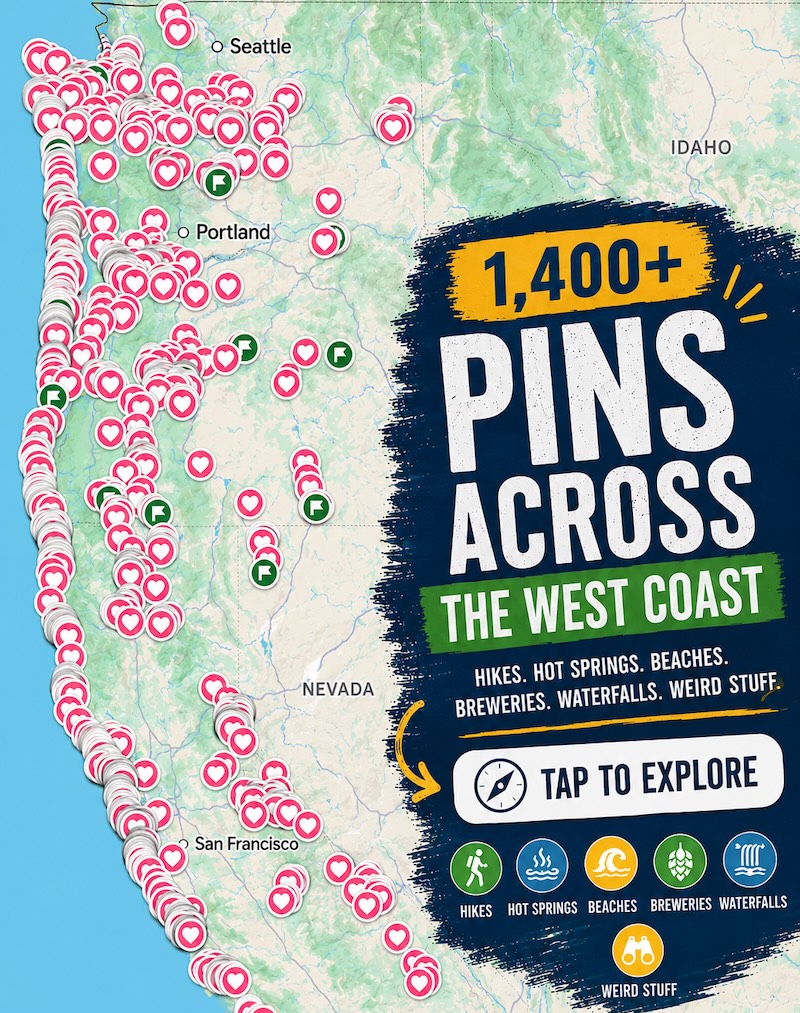
Psst — we made you a West Coast Adventure Map. Nearly 1,900 of our favorite spots, already pinned, ready to load into Google Maps in two clicks — grab it here.
A pine tree that’s been running out of room for 10,000 years
Torrey pines once spread across a much wider stretch of ancient California coastline. As the climate dried out over the last ten thousand years, the species retreated to the sandstone bluffs here and on Santa Rosa Island, and never expanded back.
The trees survive largely on fog. Their long, five-needle bundles comb moisture straight out of the coastal marine layer and condense it into water, which is close to the only way anything grows on these dry sandstone cliffs.
Warmer, drier stretches in recent years have weakened some of the older trees, leaving them more vulnerable to bark beetles. It’s not a crisis yet, but it’s the kind of thing park scientists are watching closely.
📍 GET THE ULTIMATE CALIFORNIA MAP 🗺️
Get our curated list of the best adventures and things to do north of LA loaded onto your maps with just two clicks!
✅ Waterfalls ✅ Hikes ✅ Viewpoints
✅ National Parks ✅ 1400+ Pins
The reserve itself is older than most people expect
San Diego set this land aside in 1899, decades before “state park” was even a category anyone used out here. Philanthropist Ellen Browning Scripps donated more acreage in 1936, and the reserve didn’t officially become a California state park until 1959.
It picked up its current name, Torrey Pines State Natural Reserve, in 2007. At around 2,000 acres it isn’t huge, but almost none of it feels like the rest of San Diego County.
Two short trails, two completely different hikes
Guy Fleming Trail is the one to start with: a flat, easy 0.7-mile loop with about 49 feet of elevation gain, right near the entrance. It’s also the most botanically diverse stretch in the reserve, thick with wildflowers, cacti, and ferns depending on the season.
Beach Trail is the opposite kind of hike. It’s a steeper round trip of roughly 2.3 miles with about 341 feet of elevation change, dropping through a ravine and down a genuinely slippery spiral staircase to the sand.
Stay well back from the cliff edges on the way down — this sandstone crumbles and slides more than it looks like it should. Time your visit for low tide, or the beach and tide pools at the bottom disappear under the surf.
Tide pools, and an unexpected whale-watching bonus
At the bottom of Beach Trail, Flat Rock holds small tide pools packed with sand crabs, barnacles, and anemones, best explored right at low tide when the water pulls back far enough to walk out. Bring water shoes; the rock is sharp underfoot.
Visit between mid-June and September and it’s worth glancing at the horizon. Blue whales pass along this stretch of coast through summer, and Razor Point and the upper Beach Trail overlooks are two of the better spots in the reserve to catch one.
Before you go
Day-use parking runs $10 to $25 per vehicle depending on demand, with weekdays generally cheaper than weekends and holidays. There’s no camping, no dogs, no drones, and no picnicking anywhere in the reserve, and rattlesnakes are active on the trails through summer, so stay on the marked path.
Which would pull you in first: the wildflowers on Guy Fleming, or the tide pools waiting at the bottom of Beach Trail?
Rules and fees change — always confirm current requirements before you go.