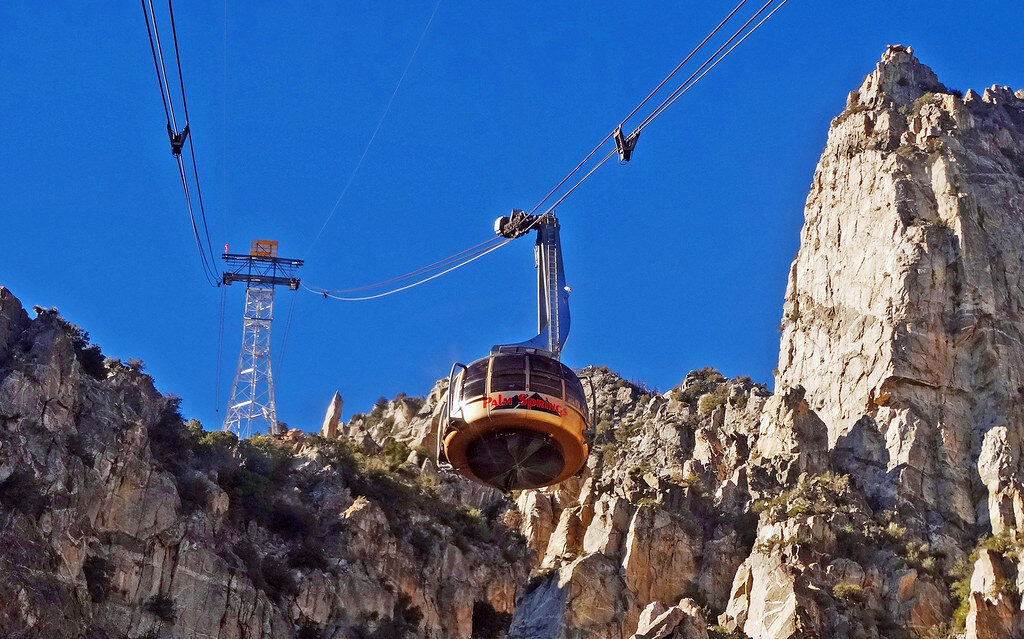
This California tram climbs almost 6,000 feet in ten minutes, and it shuts down for a month right after Labor Day
Somewhere below Palm Springs, it’s pushing 105 degrees on the valley floor. Ten minutes later, you’re standing in a pine forest that’s 30-plus degrees cooler, wondering if you accidentally drove to a different state.
That’s the entire pitch of the Palm Springs Aerial Tramway, and it delivers every time. There’s no road up this mountain — just the tram, or a trail that takes most of a day on foot.
Psst — we made you a West Coast Adventure Map. Nearly 1,900 of our favorite spots, already pinned, ready to load into Google Maps in two clicks — grab it here.
A ten-minute, 6,000-foot elevator ride
The numbers alone are worth the ticket. Valley Station sits at 2,643 feet; Mountain Station tops out at 8,516 feet, a vertical climb of nearly 5,900 feet on a ride that covers 2.5 miles in about 10 minutes.
The cars are part of the show, too. Since 2000, the tramway has run the world’s largest rotating tramcars — the floor slowly turns twice over the course of the ride, so nobody’s stuck fighting for a window seat. One opinion, held plainly: stand near the glass anyway. The rotation is slower than you’d think, and you don’t want to spend your first pass staring at the ceiling.
📍 GET THE ULTIMATE CALIFORNIA MAP 🗺️
Get our curated list of the best adventures and things to do north of LA loaded onto your maps with just two clicks!
✅ Waterfalls ✅ Hikes ✅ Viewpoints
✅ National Parks ✅ 1400+ Pins


Nice and cool — the whole point since 1935
The tramway exists because one overheated engineer got an idea. Francis Crocker was mopping his brow near Palm Springs in 1935 when he looked up at the snow still clinging to Mount San Jacinto and decided he wanted to go up there, where it was nice and cool.
It took 28 years, two vetoed state bills, a world war, and $8.15 million in private bonds to make that happen — not one cent of public money. When it finally opened in September 1963, newspapers were calling it the Eighth Wonder of the World, largely because helicopters had to fly roughly 23,000 missions just to build four of the five support towers in terrain no road could reach.
What’s waiting in the pines
Step off the tram and you’re in an entirely different ecosystem: Mount San Jacinto State Wilderness, all pine forest and granite, typically 30 degrees or more cooler than the desert floor below. It’s one of the more reliable heat escapes in Southern California, and you never have to get back in a car to reach it.
For an easy taste, the Desert View Trail is a short 1.7-mile loop with about 330 feet of climbing — enough to stretch your legs and catch a few overlooks without committing to a real hike. Want more? Round Valley Trail up to Wellman Divide runs roughly 7 miles round trip with about 1,570 feet of gain, a legitimate half-day hike through meadows and forest below San Jacinto Peak’s 10,834-foot summit.
Anything beyond the immediate station area sits inside the Wilderness, which means a free day-use permit — no reservation needed, just a stop at the ranger station the morning of your hike. Winter flips the whole mountain over to snowshoeing and cross-country skiing at the same elevation that’s baking below.
Know before you go
Here’s the part worth building a trip around: the tramway closes every year for maintenance, and the 2026 closure runs Tuesday, September 8 through Sunday, October 4 — starting the day after Labor Day. If a ride’s on your list, the weeks before that closure are your window, not the weeks after.
Through September 7, the first car up runs at 8 a.m. on weekends and holidays, 10 a.m. on weekdays, with the last car up between 8 and 9 p.m. depending on the day. Online tickets run $36.95 for adults, $33.95 for seniors, and $20.95 for kids ages 3 to 10, plus $5 for parking.
Trip tips: grab a rental car to get out here, lock in your hotel before the good rooms are gone, or skip both and book a camper van instead.
Rules and fees change — always confirm current requirements before you go.