
An earthquake cost this Central Coast lighthouse its top in 1949, and its giant lens ended up 13 miles away on a small-town main street
The most interesting lighthouse on the Central Coast is missing its whole top. Drive Highway 1 north of San Simeon and you’ll spot it: a tall white brick tower that just stops, flat as a cut-off pencil, with no lantern room crowning it.
That’s Piedras Blancas Light Station, and the story of its missing head runs through an earthquake, a rescue by a small-town service club and a 10-foot lens that now lives 13 miles down the road. Better yet, the timing right now is perfect, because the elephant seals next door are about to start their wildest season of the year.
Psst, we made you a West Coast Adventure Map. Nearly 1,900 of our favorite spots, already pinned, ready to load into Google Maps in two clicks: grab it here.
The lighthouse that lost its head
Piedras Blancas first lit up on February 15, 1875, and back then it was a showpiece. The tower stood about 100 feet tall, topped by an ornate iron lantern room on a windswept point named for the white, guano-streaked rocks just offshore.
Then an earthquake hit on the last day of 1948, and the upper tower was declared structurally unsound. In 1949, crews removed the top three levels (the fourth landing, the watch room and the lantern), leaving the roughly 70-foot stump you see today.
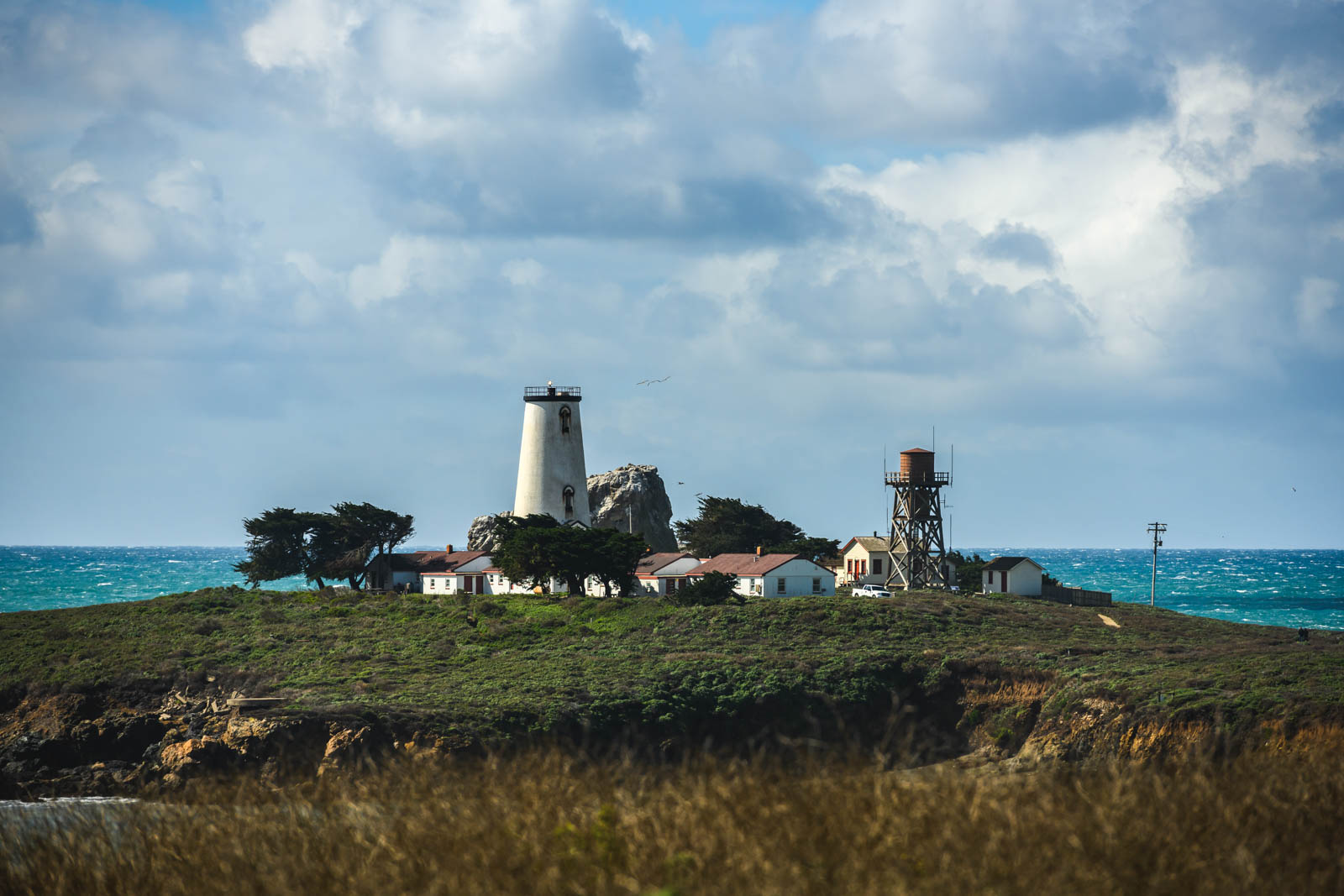
A modern beacon took over the job, and the light kept flashing. Today the Bureau of Land Management runs the whole point as a historic park and wildlife sanctuary.
📍 GET THE ULTIMATE CALIFORNIA MAP 🗺️
Get our curated list of the best adventures and things to do north of LA loaded onto your maps with just two clicks!
✅ Waterfalls ✅ Hikes ✅ Viewpoints
✅ National Parks ✅ 1400+ Pins
The giant lens took a detour to Cambria
Here’s the twist. The tower’s original first-order Fresnel lens (the biggest of the six standard sizes, about 10 feet tall and weighing several tons) was headed for storage after it came down.
Members of the Cambria Lions Club got the Coast Guard’s permission to bring it to town instead, and they lit it on their Pinedorado Grounds in 1951. Today it sits in a glass enclosure next to the Veterans Memorial Building on Main Street, clockwork mechanism and all, still on loan from the Coast Guard.
It only takes a few minutes to see. Standing next to the thing that used to sit on top of that flat tower makes the whole story click.
How to get past the gate
You can’t just wander in. Because of the sensitive wildlife and historic buildings, the light station is open by guided tour only, and from September 1 through June 14 those tours run on Tuesdays, Thursdays and Saturdays.
Tours meet at 9:45 a.m. at the former Piedras Blancas Motel, 1.5 miles north of the lighthouse, not at the lighthouse gate. Staff give a quick orientation, then you follow a lead car down to the station in your own vehicle.
From there it’s about two hours on an easy half-mile interpretive trail past the tower, the old support buildings and a whole lot of crashing surf. According to the BLM tour page, it’s $10 for adults, $5 for ages 6 to 17 and free for kids 5 and under, and you can book on Recreation.gov.
A few things to know: there are no tours on federal holidays (so skip Thanksgiving Day), the station closes over the Christmas and New Year holidays, and bad weather can cancel a tour. No pets, and bring layers, because this point gets windy fast.
The free walk right next door
Can’t make a tour morning? The Boucher Trail (say it “boo-shay”) gets you great outside views of the lighthouse for free. California State Parks finished it in 2017 and named it for Jim Boucher, a former manager of the light station.
The trail starts at the elephant seal vista point parking lot and runs north along the bluffs for about 1.9 miles, crossing the lighthouse road and ending a half mile past the station. Out and back, that’s roughly 3.8 miles of mostly flat walking, easy enough for just about anyone.

Honestly? This trail beats the main boardwalk. The crowds thin out within minutes, and the overlooks along the way stare straight down at beaches full of snoring, sand-flipping seals.
Dogs aren’t allowed and there are no restrooms along the route, so plan ahead before you set out.
Why late fall is the time to go
The Piedras Blancas rookery is the biggest mainland elephant seal colony in the country, and the viewing area is free and open every day. But late November is when things get dramatic.
According to Friends of the Elephant Seal, adult bulls weighing 3,500 to 5,000 pounds start hauling out in late November and keep arriving through December. Pregnant females follow in December, the first pup usually shows up around mid-month, and most births happen in January.
Watching two-ton bulls slam chests on the sand is something you won’t forget. Stay on the trail and behind the fences, and give these animals plenty of room.
🏨 Need a place to crash nearby?
From rustic cabins to boutique inns—check prices and availability in just a click.
Make a day of it
The light station sits about 6 miles north of Hearst Castle, so it’s an easy add-on to any drive along this stretch of coast. Do the tour or the Boucher Trail in the morning, then roll south to see the lens on Main Street.

While you’re there, our guide to the best things to do in Cambria has plenty to fill the afternoon. Heading north afterward? Our list of the best stops on a Big Sur drive and these Big Sur hikes pick up where this one leaves off.
So, which would you rather see first: the beheaded lighthouse, the lens that got away or a beach full of brawling bulls? Tell us in the comments!
Trip tips: grab a rental car to get out here, lock in your hotel before the good rooms are gone, or skip both and book a camper van instead.
Rules and fees change, so always confirm current requirements before you go.