PG&E dug a pit for a nuclear reactor on this Sonoma Coast headland, and a geologist found a fault running right through it
Bodega Head looks like a place nobody would ever dare build on: a bald granite knob, wind-flattened grass, and the Pacific slamming into cliffs on three sides. In the early 1960s, it was supposed to get a nuclear power plant.
PG&E had already started digging the hole for the reactor. Then a rancher, a waitress, a crew of Bay Area activists and one very determined geologist got in the way, and the whole project fell apart in 1964.
What’s left is a quiet, reed-lined pond locals still call the Hole in the Head, plus one of the easiest, most cinematic bluff walks on the Sonoma Coast. Here’s the story, and how to see it for yourself.
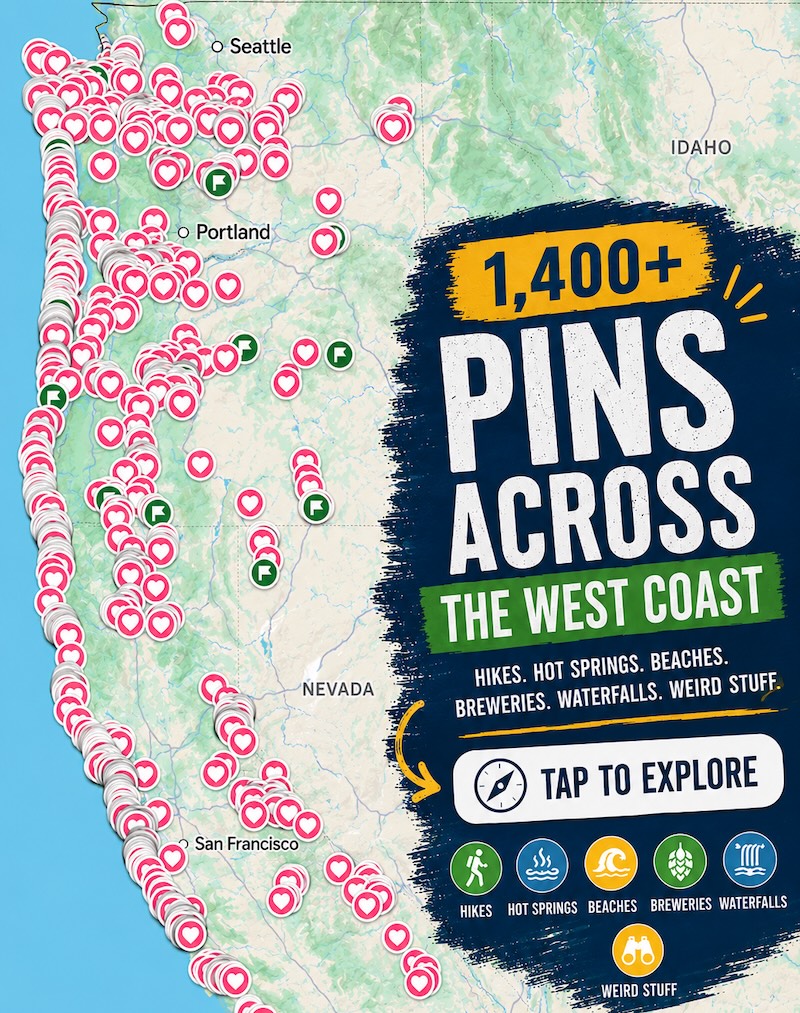
Psst, we made you a West Coast Adventure Map. Nearly 1,900 of our favorite spots, already pinned, ready to load into Google Maps in two clicks: grab it here.
The atomic park that almost happened
In 1958, PG&E bought land on Bodega Head and announced plans for a steam-electric power plant. On paper, the spot made sense: a solid granite foundation, the hungry Bay Area less than 70 miles south, and all the cold seawater a plant could want for cooling.
There was just one problem. The San Andreas Fault runs right through Bodega Bay, so the headland rides on the Pacific Plate while the town across the harbor sits on the North American Plate.
In 1961, PG&E finally confirmed the plant would be nuclear, and it was going to be called the Atomic Park. The company was so sure of approval that crews started digging the reactor pit before federal regulators had signed off.
📍 GET THE ULTIMATE CALIFORNIA MAP 🗺️
Get our curated list of the best adventures and things to do north of LA loaded onto your maps with just two clicks!
✅ Waterfalls ✅ Hikes ✅ Viewpoints
✅ National Parks ✅ 1400+ Pins
A rancher, 1,500 balloons and a fault in the pit
Rose Gaffney owned 408 acres out on the head, and she refused to sell to PG&E. She was known to greet uninvited visitors to her ranch with a shotgun, which tells you roughly how those negotiations went.
Hazel Bonnecke, a waitress at a Bodega Bay restaurant who regularly served PG&E officials their lunch, led a petition drive against the plant. Activists got creative, too.
On Memorial Day 1963, they let 1,500 helium balloons loose from the headland, each tagged as a stand-in for a radioactive particle drifting downwind. Some turned up in the Central Valley, more than 100 miles away.
The knockout punch was geology. On a rainy day with nobody manning the gate, geologist Pierre Saint-Amand walked onto the site and found a fault running straight through the reactor pit, and his 1963 report said a worse foundation was hard to imagine.
Work on the pit stopped that October. A year later, federal regulators ruled Bodega Head unsuitable for the plant, and on Oct. 30, 1964, PG&E pulled its application. Some historians trace the American anti-nuclear movement straight back to this fight.

The Hole in the Head today
By the time PG&E walked away, the pit was more than 70 feet deep. Natural springs (the same ones that drew Miwok people here long before anyone talked about reactors) filled it back up, and now it’s a calm pond ringed with reeds and full of noisy birds.
You can spot it from Westshore Road as it climbs toward the Bodega Head parking lots, near Campbell Cove. It’s a weirdly peaceful view once you know what was supposed to be standing there.
The land didn’t go to waste, either. The university’s Bodega Marine Laboratory opened on the head in 1966, and the bluffs around it are now part of Sonoma Coast State Park.
Walking the Bodega Head loop
This one’s easy: the Bodega Head Trail is about a 1.7-mile loop, mostly flat with one gentle climb, so you’ll finish in under an hour even if you stop every five minutes to stare. And you will.
The trail traces the rim of the headland, with the harbor and Bodega Bay on one side and wide-open Pacific on the other. On a clear day, the view runs south toward Tomales Point and Point Reyes.
The granite drops off fast out here, so stay well back from the cliff edges. For the effort, this is the best short walk on the Sonoma Coast, full stop.

Parking at Bodega Head is free, since the state park only charges day-use fees at its campground lots. There are two lots and the loop connects them, so grab whichever one has space.
Come back in winter for the whales
Gray whales pass close to Bodega Head on their migration, and Sonoma County calls it its top spot for whale watching from land. Bring binoculars and scan past the rocks for a puffy, heart-shaped spout.
From January through May, volunteer docents with Stewards of the Coast and Redwoods usually set up on the bluff on weekends from 10 a.m. to 2 p.m., weather permitting. They’re great at spotting blows you’d have missed completely.
Can’t wait that long? Late fall is a nice in-between: way fewer people than summer, when holiday crowds can overwhelm the small lots.
🏨 Need a place to crash nearby?
From rustic cabins to boutique inns—check prices and availability in just a click.
Make a day of it
Bodega Bay’s harbor is just a few minutes back down the road for chowder and boat-watching. Got more time? Keep driving north on Highway 1 toward Salt Point State Park, or head inland to Santa Rosa for the night.

Trip tips: grab a rental car to get out here, lock in your hotel before the good rooms are gone, or skip both and book a camper van instead.
So, would you have guessed this headland almost became a nuclear plant? Tell us your favorite Sonoma Coast walk in the comments.
Rules and fees change, so always confirm current requirements before you go.