This California lighthouse survived the tsunami that wrecked 29 city blocks, and you can only walk to it at low tide
Most lighthouses stand guard over the ocean. Battery Point Lighthouse in Crescent City has to share an island with it, and when the tide comes in, the Pacific cuts it off from the rest of California completely.
That tiny island is the whole appeal. First lit on December 10, 1856, this is one of the first lighthouses on the California coast, and on one terrifying night in 1964 it rode out a tsunami that tore through the town across the harbor.
Psst, we made you a West Coast Adventure Map. Nearly 1,900 of our favorite spots, already pinned, ready to load into Google Maps in two clicks: grab it here.
A walk across the seafloor
Getting there is half the fun. The lighthouse sits on a small islet off Battery Point, linked to the mainland by a rocky crossing of about 200 feet that only shows itself at low tide.
When the water is out, you pick your way over wet, tide-polished rocks with the harbor on one side and the open Pacific on the other. When it’s in? The island is an island again, and you’re admiring it from the parking lot.

The Del Norte County Historical Society, which runs the lighthouse, asks visitors to stay off the crossing whenever waves could wash over it and to watch for sneaker waves near the rocks. The tide can return faster than you’d expect, so check the tide table before you head out.
📍 GET THE ULTIMATE CALIFORNIA MAP 🗺️
Get our curated list of the best adventures and things to do north of LA loaded onto your maps with just two clicks!
✅ Waterfalls ✅ Hikes ✅ Viewpoints
✅ National Parks ✅ 1400+ Pins

The night the light kept flashing
On Good Friday, March 27, 1964, a massive earthquake in Alaska sent tsunami waves down the coast. Curators Peggy and Clarence “Roxey” Coons were living in the lighthouse, and a little before midnight Peggy looked out to see the rocks around the island had disappeared underwater.
The biggest wave crested at nearly 21 feet, killed eleven people, and devastated 29 city blocks of Crescent City. In Peggy’s written account, one huge wall of water split around the island while the couple headed for the tower.
The lighthouse came through intact, and its light kept flashing all night. Standing out there today with the harbor calm and the gulls yelling, it’s hard to picture, until you look back at town and realize how close it all is.
What’s inside
Volunteer keepers still live on site, which gives the place a lived-in feel instead of a roped-off one. Tours take you through the keepers’ quarters, furnished with pieces dating to the 1850s, plus maritime artifacts, old photos, and documents.
The best part is the climb up into the light tower. A fourth-order Fresnel lens sits on display in the museum, while a modern beacon up top still shines as a private aid to navigation.
Our take: the low-tide crossing is the real star here, even more than the tour. Show up early, poke around the rocks, then head inside.
When to go
From April through September, tours run daily from 10 a.m. to 4 p.m., tide permitting. Outside that window the lighthouse typically opens on weekends, and every visit still depends on the tide, so check the historical society’s lighthouse page before you make the drive.
Fall is a great time to go, with the summer road-trip rush behind you. Just plan your day around the tide chart, not the other way around.
Make a day of Crescent City
Want the tsunami story from the town’s side? Crescent City has a self-guided tsunami walking tour that starts at a big white jetty dolos on Front Street, with stops showing high-water marks on surviving buildings and memorials to the people who died.
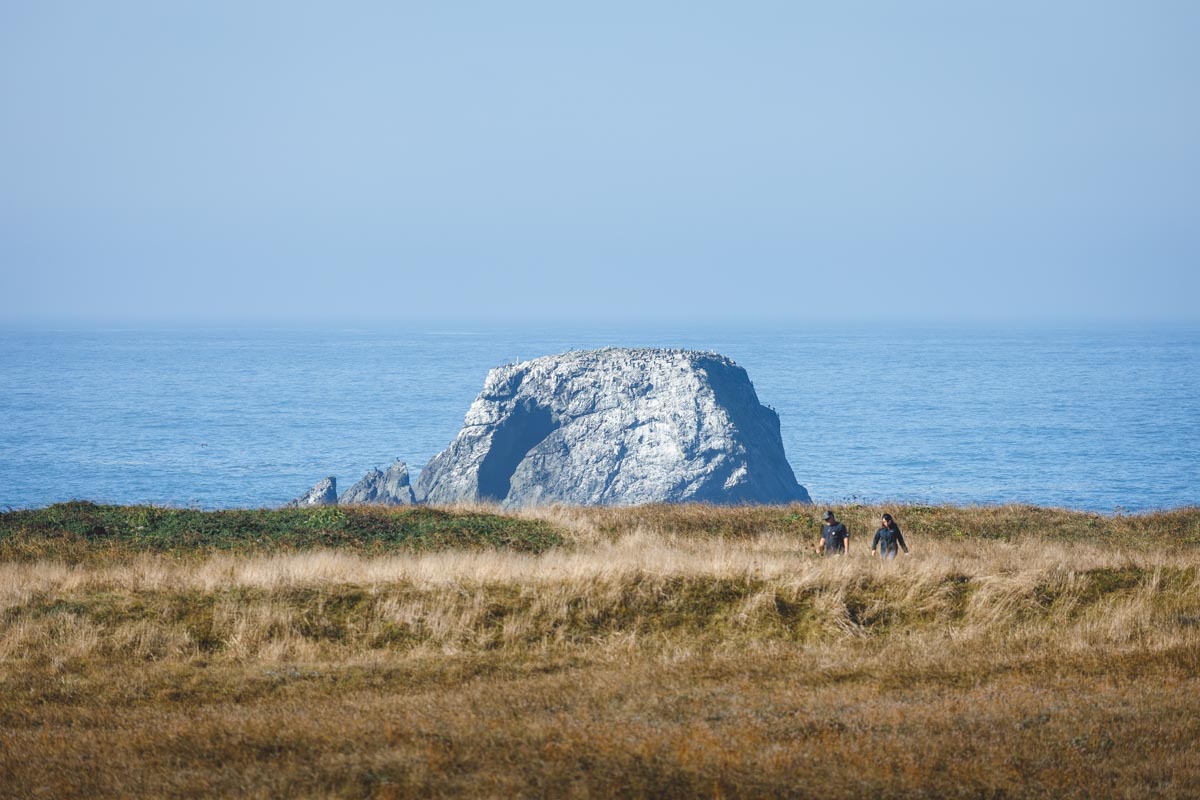
From there, you’ve got options. Head to the bluff trails at Point St. George, where on a clear day you can spot another lighthouse far out on the reef, or go watch the surfers at Crescent Beach. Our list of things to do in Crescent City has the rest.
And yes, the redwoods are right there. Jedediah Smith Redwoods sits just inland, and our guide to Redwood National and State Parks breaks down how the whole park system fits together.

Trip tips: grab a rental car to get up here, lock in your hotel before the good rooms are gone, or skip both and book a camper van instead.
So, would you make the low-tide crossing or wave at the island from shore? Tell us which side of the rocks you’d be on.
Rules and fees change, so always confirm current requirements before you go.